Leon Butler · 9 September 2026
How Bog Sediments Support Climate Control in Isolated Northern Homes
Isolated northern homes often rely on local materials for thermal regulation because conventional energy sources remain limited or costly in remote regions and bog sediments provide one such resource through their natural insulating properties and moisture retention capabilities. Researchers have documented how these organic deposits formed from accumulated plant matter in wetlands trap air and water in ways that moderate indoor temperatures during extreme seasonal shifts common above the 60th parallel. Data from field studies indicate that homes incorporating processed bog sediments into walls or foundations experience reduced heat loss compared to structures using only standard lumber or concrete and this effect stems from the material's low thermal conductivity which averages between 0.05 and 0.08 watts per meter kelvin according to measurements collected across Canadian subarctic sites.
Composition and Formation of Bog Sediments
Bog sediments consist primarily of partially decomposed sphagnum moss along with other wetland vegetation that has accumulated over centuries in oxygen-poor environments and the resulting peat-like layers contain high percentages of carbon and lignin that contribute to both structural stability and heat retention when harvested and dried for building use. Observers note that these sediments develop distinct strata with varying densities where upper fibrous layers offer better insulation while deeper compacted sections provide thermal mass that absorbs daytime warmth and releases it slowly during long winter nights. Studies conducted by teams from Natural Resources Canada have mapped sediment profiles in boreal zones showing consistent patterns of mineral content including iron and aluminum compounds that enhance fire resistance when sediments are mixed into plaster or insulation boards.
Integration Methods in Remote Construction
Builders in isolated northern communities prepare bog sediments through a process of extraction followed by drying and screening to remove excess water and larger debris then they combine the refined material with binders such as clay or lime to create panels or infill for timber-framed walls. This approach allows residents to source materials locally which reduces transportation emissions and costs while the sediments' hygroscopic nature helps regulate indoor humidity levels by absorbing excess moisture in summer and releasing it gradually in winter. Evidence from projects in northern Quebec demonstrates that homes using sediment-based insulation maintain indoor temperatures between 18 and 22 degrees Celsius with minimal supplemental heating during periods when outdoor readings drop below minus 30 degrees Celsius and similar techniques appear in Finnish Lapland where local research institutions have tested sediment composites for flooring underlays.
Climate Regulation Benefits and Supporting Data
Bog sediments contribute to climate control not only through direct insulation but also by supporting broader carbon sequestration efforts since undisturbed bogs store large quantities of atmospheric carbon and sustainable harvesting practices can maintain this balance when extraction rates stay below annual accumulation rates. Figures from monitoring programs reveal that homes retrofitted with sediment insulation in the Northwest Territories recorded a 25 percent drop in annual heating fuel consumption between 2020 and 2024 while parallel observations in Alaska showed comparable reductions in cooling demands during brief summer heat events. What's interesting is how the material's ability to buffer temperature swings decreases reliance on fossil fuel generators in off-grid settings and this in turn lowers overall greenhouse gas outputs from individual households.
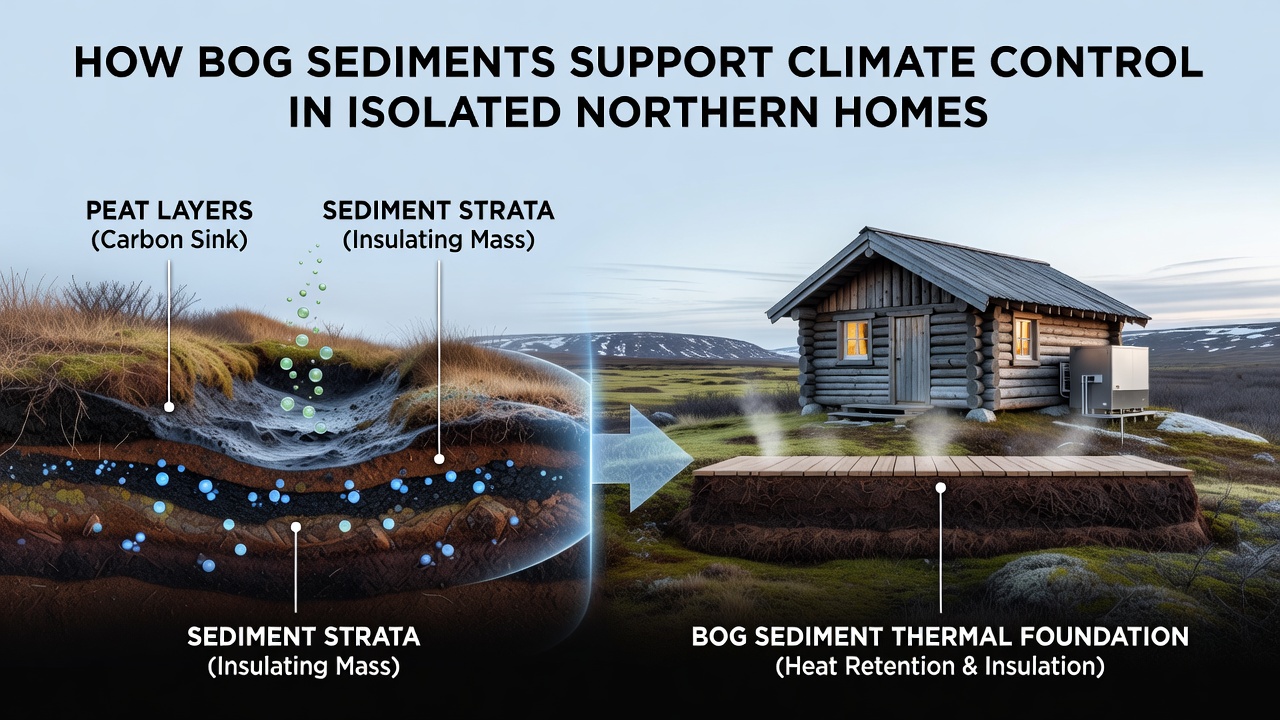
Additional benefits emerge when sediments are applied in combination with passive solar design elements such as south-facing windows and earthen floors where the stored heat from daytime sunlight interacts with the sediment mass to extend warmth into evening hours. Research indicates that such integrated systems perform particularly well in areas with permafrost because the sediments create a stable thermal barrier that limits ground thawing around foundations and thereby reduces structural shifting risks. Data collected through 2025 from multiple sites across Scandinavia and North America confirm these patterns with average energy savings ranging from 18 to 32 percent depending on sediment thickness and local climate variables.
Recent Developments and September 2026 Projections
Monitoring efforts continue to expand with new sensor networks installed in test homes across Yukon and Nunavut during 2025 and preliminary readings suggest further refinements in sediment processing could improve performance metrics by an additional 10 percent. Plans announced for September 2026 include a collaborative workshop hosted by academic partners in Tromsø Norway where engineers will review updated sediment harvesting guidelines alongside representatives from the European Environment Agency to standardize best practices for northern applications. These sessions aim to incorporate findings from ongoing carbon flux measurements that track how harvested bogs recover their storage capacity over time and the outcomes may influence construction codes in several circumpolar nations.
Considerations for Long-Term Use
Maintenance requirements involve periodic inspection of sediment-based components to ensure moisture levels remain within optimal ranges because excessive saturation can reduce insulating effectiveness while prolonged dryness may lead to cracking in composite panels. Communities that have adopted these methods report successful outcomes when local knowledge guides harvesting locations and timing with spring collection often preferred to allow natural drying before winter installation. Ongoing trials explore additives such as biochar derived from regional wood waste to enhance durability and microbial resistance without compromising the material's environmental profile.
Conclusion
Bog sediments offer a regionally appropriate solution for climate control in isolated northern homes by combining insulation properties with humidity regulation and carbon storage functions that align with local environmental conditions. Continued documentation of performance data supports wider consideration of these materials in sustainable building strategies while collaborative research scheduled for 2026 may refine application techniques further. The integration of such resources reflects practical adaptation to remote settings where access to conventional materials remains constrained.